
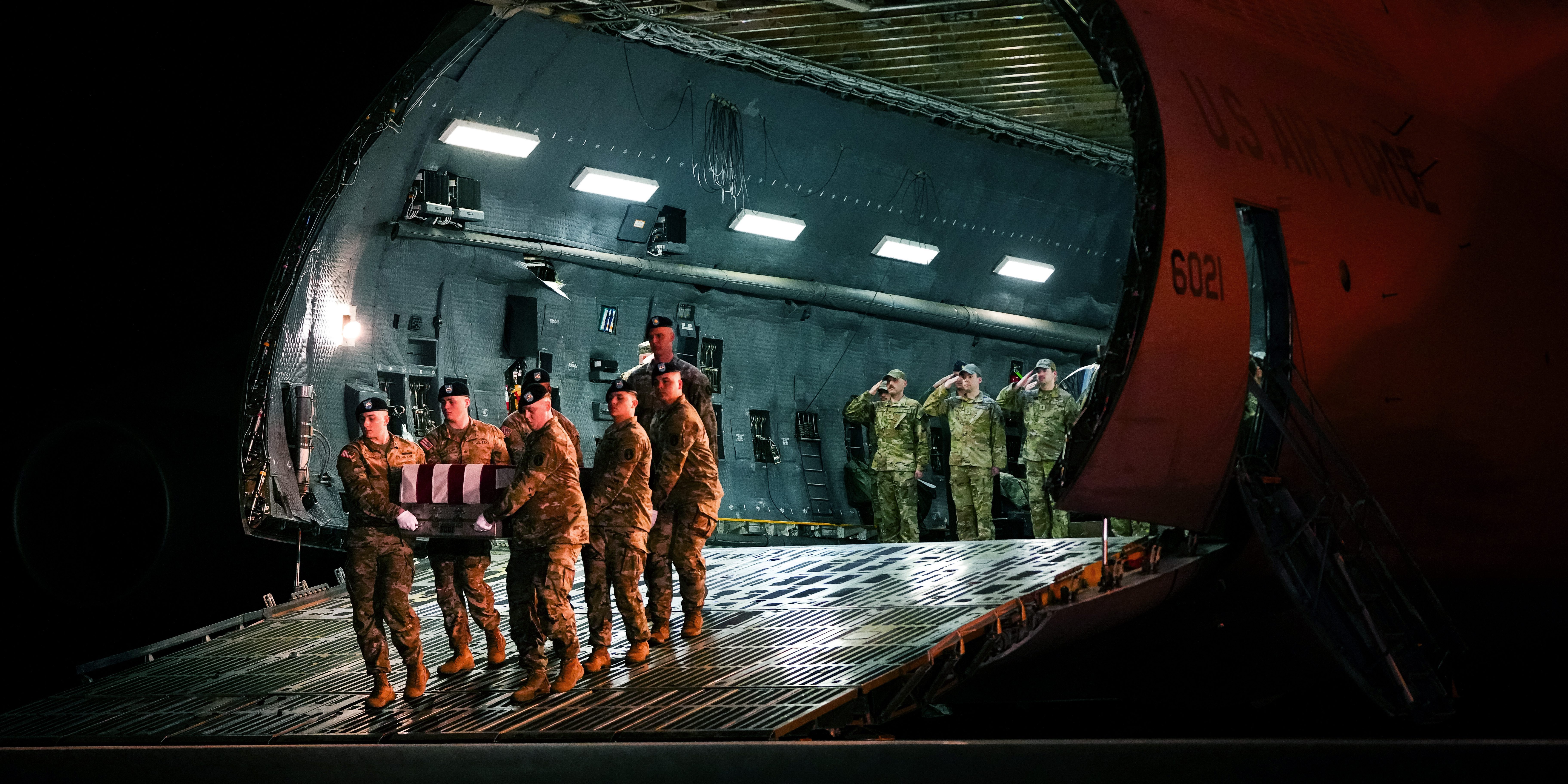
The Pentagon quietly acknowledged additional Iran war deaths on Friday evening after The Intercept repeatedly demanded an explanation for inaccurate statistics on a War Department website tracking U.S. casualties from the conflict.
Almost 900 U.S. troops have been wounded or killed in the war with Iran, according to the official Pentagon count, including the two deaths added on Friday. This raises the Pentagon’s total to 21 dead.
The additional war dead include Maj. Sorffly Davius, a signals and communication officer with the New York Army National Guard who was assigned to the headquarters of the 42nd Infantry Division and died while on duty in Camp Buehring, Kuwait, on March 6. For more than six months, The Intercept has raised Davius’s case in dozens of emails and phone conversations with Pentagon officials and publicly in 10 articles.
The Pentagon recently revamped the website of the Defense Casualty Analysis System, or DCAS — which provides official counts of dead and wounded for Congress and the White House — to include more detailed casualty category tables. But it initially listed no “non-hostile” illness or injury fatalities, despite the Pentagon announcing in March that Davius died “as a result of a non-combat related incident.”
At first, the military claimed that Davius was involved in another operation instead of Epic Fury — the original designation of the Iran war. Two weeks ago, however, The Intercept revealed that a recent National Guard news release admitted that when “President Donald Trump made the decision to attack Iran and launched Operation Epic Fury on Feb. 28, the [42nd Infantry] division headquarters began conducting combat operations.” The 42nd served as the primary headquarters leading what became, according to Maj. Gen. Jack James, the division commander, the “largest and first long-range precision fires campaign in the history of the United States Army.” James specifically saluted Davius, whom the Guard admitted was “conducting operations” when he died.
Last week, The Intercept pointed the Pentagon to the non-hostile illness or injury casualty count for Epic Fury on the website, and emphasized its tally showing zero deaths was not possible.
“I will check within,” Patricia Kreuzberger, a Pentagon spokesperson said on Tuesday. “Let me reach out to leadership.”
Three days later, and after repeated follow-up messages on Friday, the tally was updated, to 1.

In addition to Davius, the DCAS death count now also includes an unidentified Navy suicide that occurred last month, according to a U.S. official who spoke on the condition of anonymity. DCAS currently lists this death as “pending,” despite the recent addition of a “self-inflicted” category to the website.
A “War Department official” told The Intercept by email on Sunday that “the Department is introducing a ‘Pending Adjudication’ category to track the status of active duty casualties pending final categorization and reporting in DCAS.” She added: “This new category will allow the Department to minimize reporting delays while ensuring data consistency between the DoW and Joint Staff.”
The “pending” designation, however, isn’t new. The Pentagon re-introduced it to DCAS in mid-July, and major discrepancies have continued in the tally since.
Many casualties remain uncounted in DCAS, including a sailor who suffered a non-combat-related injury aboard the USS Abraham Lincoln as it was involved in “strike missions in support of Operation Epic Fury” on March 25.
Most Iran war casualties in the official count — 454 personnel as of Friday — have occurred since July 7, after the Trump administration claimed the conflict ended. At that time, the Pentagon switched from counting casualties under Epic Fury to the anodyne moniker “Overseas Operations.”
The most recent casualties are three Army personnel wounded in action this month. The latest known Iran war fatality is Capt. Bianca Wilkerson, 37, of Norfolk, Virginia, who died on September 18 from a “coronary issue,” according to her brother. He said she returned from Saudi Arabia on September 10 and was headed back but died on the return flight, according to reporting by the Virginian-Pilot. A U.S. official told The Intercept that Wilkerson died “as a result of a non-combat-related incident,” but after nearly a month, DCAS still lists no non-hostile illness or injury deaths.
“There is no excuse for a mistake of this magnitude,” Reps. Chrissy Houlahan, D-Pa., and Adam Smith, D-Wash., said in a joint statement on Friday after the House Armed Services Committee discovered “a discrepancy in the Pentagon’s reporting of casualty numbers” and brought it to “the Trump Administration’s attention.” They continued: “The failure of Secretary Hegseth to immediately take ownership of the problem also does a grave disservice to the men and women putting their lives on the line in service to our country.”
For six months, The Intercept has reported on anomalies in official counts offered on DCAS. When the first ceasefire was struck between the Trump administration and Iran on April 7, the tally of U.S. casualties was 385. Despite a pause in hostilities, the number slowly rose to 428, according to Pentagon statistics. But on April 21, the number of wounded-in-action troops declined by 15 without public acknowledgment by the War Department. Despite repeated questions for months, the Pentagon has not explained the adjustment.
Other discrepancies have also gone unjustified for months. An Army “illness/injury” death appeared on or about May 26 but disappeared by June 1. On July 20, the Pentagon repeatedly altered DCAS, adding 100 casualties to the war’s tally without explanation; the total number of wounded cited by DCAS on that date included counts of 413, 427, and 447. Three days later, the Pentagon dropped the Iran war death toll from 18 to 14. On July 22, DCAS added 10 recent casualties to the Epic Fury count. By July 25, those wounded personnel were dropped from the tally. They may have been added to the Overseas Operations casualty toll, but the Pentagon has failed to offer any explanations.
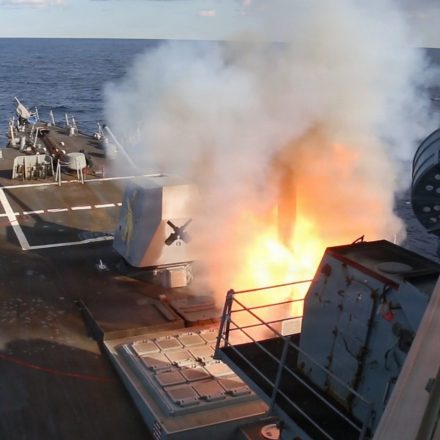
Prior reporting by The Intercept also found that the Pentagon’s official tally of dead and wounded personnel is a gross undercount, stemming from what one U.S. government official called, in April, a “casualty cover-up.” When the Washington Post also suggested last month that the Pentagon had suppressed the casualty numbers, self-styled War Secretary Pete Hegseth called the report “DISGUSTING and FAKE.”
When asked by The Intercept about the Pentagon’s continued peddling of bogus statistics, Kreuzberger did not offer an explanation. An email from a nameless “War Department official” said: “We have nothing to provide beyond the Defense Casualty Analysis System website.”
IT’S EVEN WORSE THAN WE THOUGHT.
What we’re seeing right now from Donald Trump is a full-on authoritarian takeover of the U.S. government.
This is not hyperbole.
Court orders are being ignored. MAGA loyalists have been put in charge of the military and federal law enforcement agencies. The Department of Government Efficiency has stripped Congress of its power of the purse. News outlets that challenge Trump have been banished or put under investigation.
Yet far too many are still covering Trump’s assault on democracy like politics as usual, with flattering headlines describing Trump as “unconventional,” “testing the boundaries,” and “aggressively flexing power.”
The Intercept has long covered authoritarian governments, billionaire oligarchs, and backsliding democracies around the world. We understand the challenge we face in Trump and the vital importance of press freedom in defending democracy.
We’re independent of corporate interests. Will you help us?
IT’S BEEN A DEVASTATING year for journalism — the worst in modern U.S. history.
We have a president with utter contempt for truth aggressively using the government’s full powers to dismantle the free press. Corporate news outlets have cowered, becoming accessories in Trump’s project to create a post-truth America. Right-wing billionaires have pounced, buying up media organizations and rebuilding the information environment to their liking.
In this most perilous moment for democracy, The Intercept is fighting back. But to do so effectively, we need to grow.
That’s where you come in. Will you help us expand our reporting capacity in time to hit the ground running in 2026?
We’re independent of corporate interests. Will you help us?

I’M BEN MUESSIG, The Intercept’s editor-in-chief. It’s been a devastating year for journalism — the worst in modern U.S. history.
We have a president with utter contempt for truth aggressively using the government’s full powers to dismantle the free press. Corporate news outlets have cowered, becoming accessories in Trump’s project to create a post-truth America. Right-wing billionaires have pounced, buying up media organizations and rebuilding the information environment to their liking.
In this most perilous moment for democracy, The Intercept is fighting back. But to do so effectively, we need to grow.
That’s where you come in. Will you help us expand our reporting capacity in time to hit the ground running in 2026?
We’re independent of corporate interests. Will you help us?
Contact the author:

Related
Latest Stories

Chilling Dissent
Trump Wanted Minneapolis 15 Case to Be Another Prairieland. Instead, Twin Cities Rallied Behind Anti-ICE Activists.
The mainstream of Minnesota’s left-of-center politics — including unions, the backbone of Democratic power — are behind the radical left.

Israel’s War on Gaza
A C-Section in Shackles: A Palestinian Woman’s Harrowing Birth in Israeli Detention
Dana Joudeh was denied proper food and medical care throughout her pregnancy in an Israeli prison. She gave birth to a premature baby surrounded by armed guards.

ICE Shooting in NYC Inflames Mamdani’s Policing Problem
After ICE shot a young father in Manhattan, New Yorkers asked the mayor to protect them from his police department and federal agents alike.