
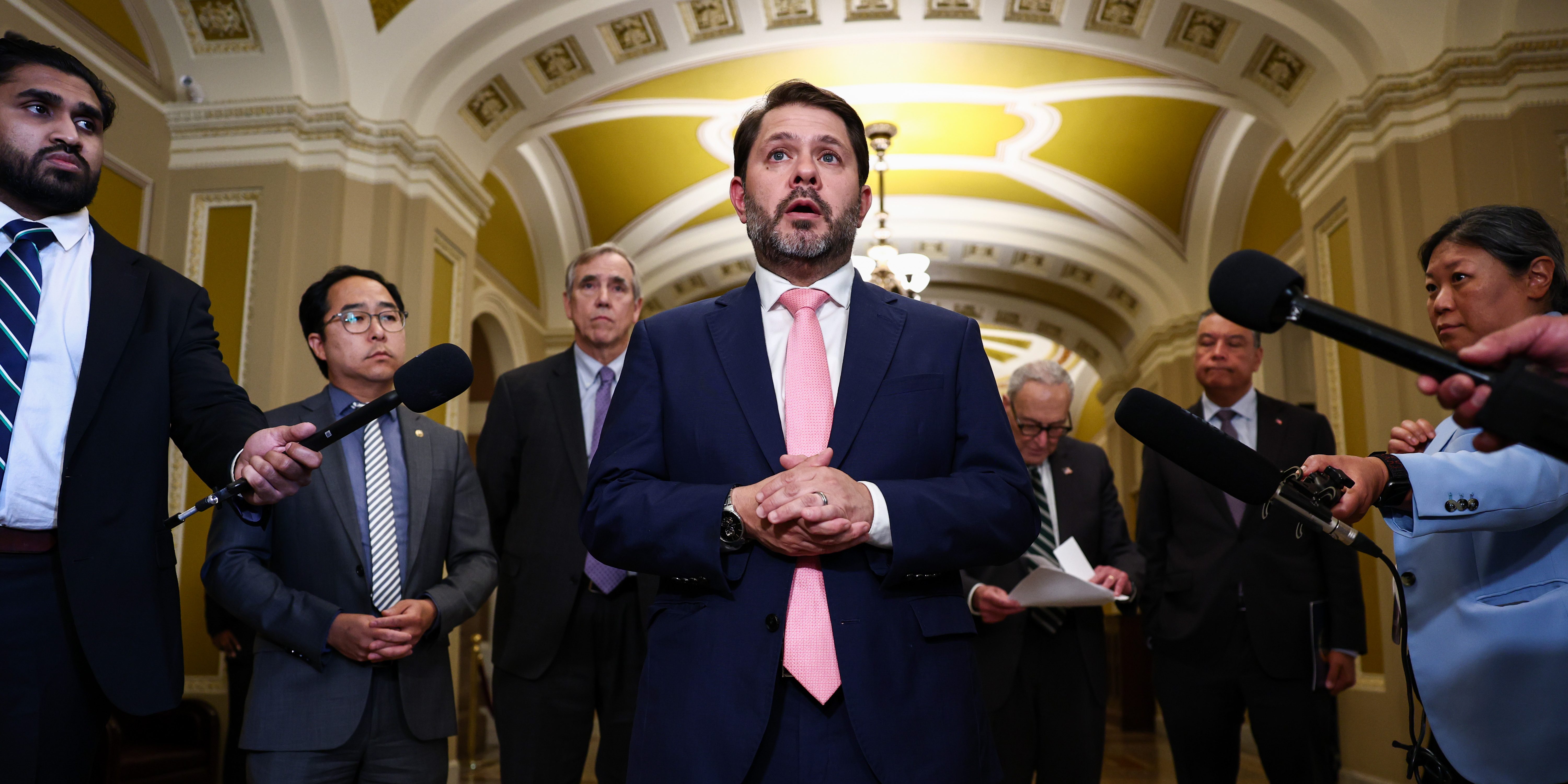
The latest version of a sweeping crypto bill exposed a deep divide between progressives and moderate Senate Democrats: whether to accommodate the industry ahead of the fall midterms, or declare open war on it.
Seven Democrats issued a statement Wednesday night lamenting that they cannot vote for the latest draft of the bill, citing weak provisions aimed at tamping down Donald Trump’s crypto self-enrichment, among other issues. In a joint statement, they pledged to keep working with Republicans to “get this over the finish line.”
Other Democrats say they have had enough of crypto, however. The problems with the bill run much deeper than Trump’s corruption, Sen. Chris Murphy, D-Conn., said at a Wednesday speech, and it is time for Democrats to openly break with the industry and its $189 million in campaign funds.
“This bill is in front of the Senate because the industry paid for it,” Murphy said. “We should, in this election, make crypto’s purchase of our political process, AI’s purchase of our political process, a major campaign issue.”
“This bill is in front of the Senate because the industry paid for it.”
The two sides staked out their position as Republicans released a draft text of the far-reaching bill known as the Clarity Act, which would create an industry-friendly regulatory structure for cryptocurrencies.
Critics say there are many problems with the bill, including lax consumer protections and loopholes that would enable money laundering. Nothing in the monthslong fight over the legislation has generated as much controversy as Trump’s self-dealing, however.
Between the $TRUMP meme coin and other ventures, Trump profited at least $1.4 billion off crypto last year. Democrats have proposed requiring Trump to divest himself of his crypto ventures and put enforcement in the hands of Democratic state attorneys general.
Instead, Republicans issued a proposal, with Trump’s blessing, that would prevent him from issuing new meme coins and put enforcement in the hands of his own Department of Justice and would not be enforceable after he leaves office.
No matter what’s in the legislation, the bill is meaningless if it leaves enforcement to Trump’s own administration, said Mark Hays, the associate director for cryptocurrency and financial technology at Americans for Financial Reform and Demand Progress.
“I don’t think anybody who is following the DOJ seriously thinks they will do that,” he said. “That is just not how this administration works.”


Even Sen. Adam Schiff, a California Democrat who has often sided with crypto in the past, said he opposes the language in the bill addressing Trump. Schiff told reporters at the Capitol that that text gives the appearance it applies to Trump and his family without actually doing so.
“It’s a complete nonstarter,” he said.
The bill’s flaws led the seven mostly centrist Democrats to issue a statement hours after the release of the draft text saying that they could not vote for it in its current form.
“Key provisions including those addressing ethics for elected officials, consumer protection, illicit finance, conflicts of interest and market integrity must be strengthened. We have been working in good faith with our Republican colleagues for the past year and will continue doing so to get this over the finish line,” said the group, which included Sen. Angela Alsobrooks, D-Md., one of the top negotiators on the bill.
The time for Democrats and Republicans to reach a compromise is slipping fast, however. The Senate goes into recess on August 7, and few observers expect Congress to take the measure up again as the midterms approach.
Senate Majority Leader John Thune said that he hopes to put the measure to a vote before senators leave town.
Democrats are nervously eying the industry’s war chest if they are put on the record as opposing the Clarity Act. Companies including Coinbase, the largest publicly traded crypto company, have contributed $189 million into super PACs and candidate campaign funds to influence the midterms.
In the past, some of the spending has benefited Democrats such as Sen. Ruben Gallego, D-Ariz. Yet it may have also contributed to Democrats losing the Senate in 2024.
Murphy, in the Wednesday speech at the Center for American Progress, said it would be better to attack the industry than try to work with it.
“They are spending money in order to get a pro-crypto bill passed through the United States Senate and House of Representatives,” Murphy said. “And there are, I guess, two approaches that the Democratic Party could take. One approach is to just do what the crypto industry wants and then cross our fingers and hope they don’t spend money against us in the next election. Good luck with that strategy. The second approach is to make the industry’s brazen attempts to buy our political process a campaign issue.”
IT’S EVEN WORSE THAN WE THOUGHT.
What we’re seeing right now from Donald Trump is a full-on authoritarian takeover of the U.S. government.
This is not hyperbole.
Court orders are being ignored. MAGA loyalists have been put in charge of the military and federal law enforcement agencies. The Department of Government Efficiency has stripped Congress of its power of the purse. News outlets that challenge Trump have been banished or put under investigation.
Yet far too many are still covering Trump’s assault on democracy like politics as usual, with flattering headlines describing Trump as “unconventional,” “testing the boundaries,” and “aggressively flexing power.”
The Intercept has long covered authoritarian governments, billionaire oligarchs, and backsliding democracies around the world. We understand the challenge we face in Trump and the vital importance of press freedom in defending democracy.
We’re independent of corporate interests. Will you help us?
IT’S BEEN A DEVASTATING year for journalism — the worst in modern U.S. history.
We have a president with utter contempt for truth aggressively using the government’s full powers to dismantle the free press. Corporate news outlets have cowered, becoming accessories in Trump’s project to create a post-truth America. Right-wing billionaires have pounced, buying up media organizations and rebuilding the information environment to their liking.
In this most perilous moment for democracy, The Intercept is fighting back. But to do so effectively, we need to grow.
That’s where you come in. Will you help us expand our reporting capacity in time to hit the ground running in 2026?
We’re independent of corporate interests. Will you help us?

I’M BEN MUESSIG, The Intercept’s editor-in-chief. It’s been a devastating year for journalism — the worst in modern U.S. history.
We have a president with utter contempt for truth aggressively using the government’s full powers to dismantle the free press. Corporate news outlets have cowered, becoming accessories in Trump’s project to create a post-truth America. Right-wing billionaires have pounced, buying up media organizations and rebuilding the information environment to their liking.
In this most perilous moment for democracy, The Intercept is fighting back. But to do so effectively, we need to grow.
That’s where you come in. Will you help us expand our reporting capacity in time to hit the ground running in 2026?
We’re independent of corporate interests. Will you help us?
Contact the author:

Related


Latest Stories

Voices
An Arkansas Mom Obtained Public Records About a New Data Center. Then She Got Sued.
Cases in Arkansas and California show how desperately we need a federal law against lawsuits intended to chill free speech.

The War on Immigrants
Don’t Stop at ICE, Says Progressive Dem: Abolish the Department of Homeland Security
Rep. Delia Ramirez is bringing a bill to eliminate DHS a day after the raid on Rep. Ilhan Omar’s home.

Voices
ICE Raid on Ilhan Omar Shows How Dangerous Two Years of Flailing Trump Could Get
With his popularity tanking and his grip on power growing tenuous, Trump is becoming a decrepit tyrant — and the checks to stop him are failing.