
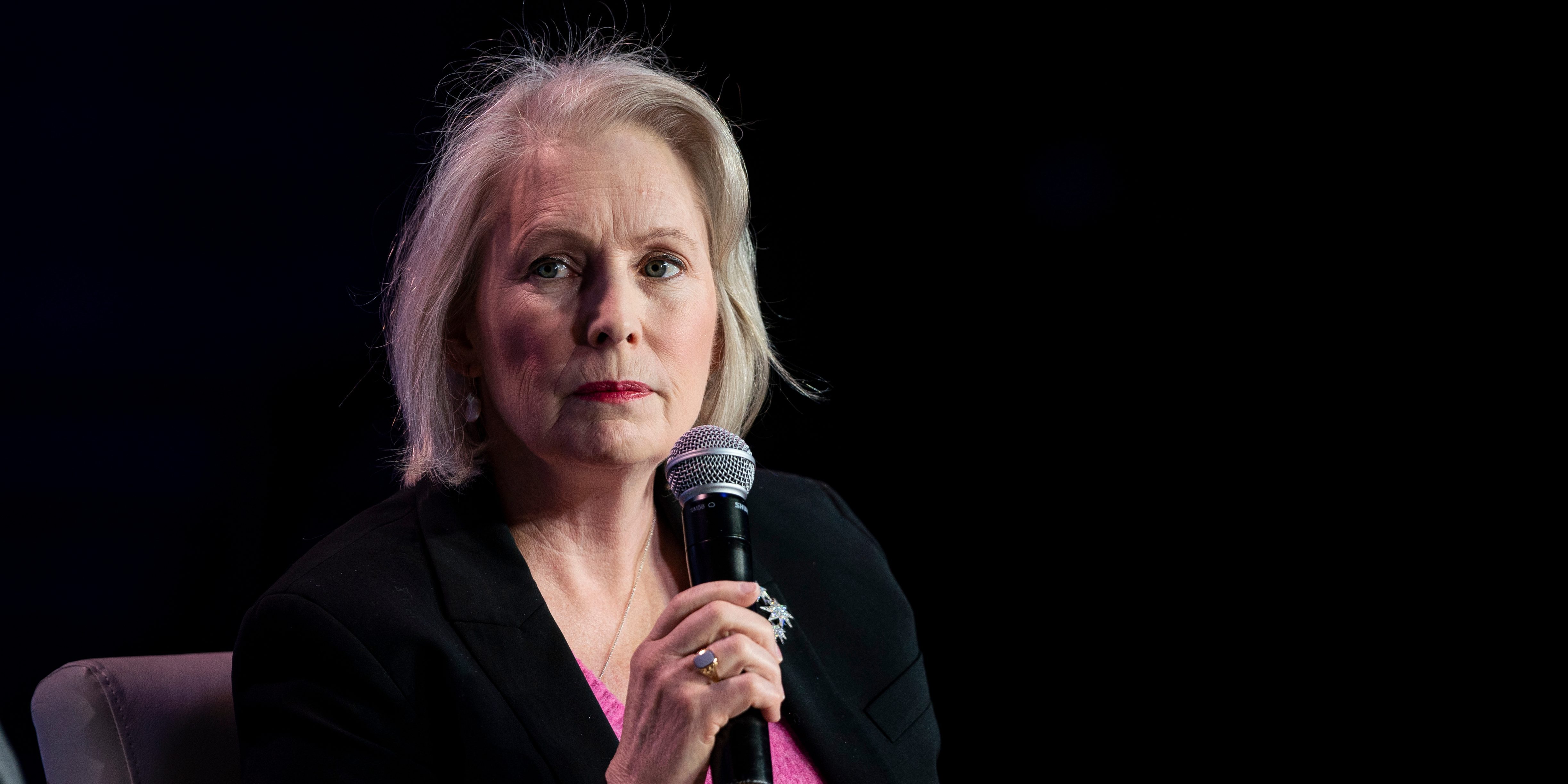
Hours before joining progressives to block a crypto bill that critics said was a handout to President Donald Trump, a top Senate Democrat was lobbying her colleagues to pass the legislation.
Sen. Kirsten Gillibrand, D-N.Y., a centrist who leads the Democratic Senatorial Campaign Committee, privately urged fellow Democrats to support advancing a crypto bill that would have created a regulatory framework for the industry, according to reporting in Politico.
Her pleas fell on deaf ears, however, as progressives including Sen. Elizabeth Warren, D-Mass., mounted a public campaign against the bill. The critics said the bill would allow President Donald Trump to add to the $1.4 billion in crypto profits he pocketed last year.
When it came time for the final vote, Gillibrand joined all Democrats in voting against a motion to advance the bill. Four Republicans also voted against the motion, which fell far short of the 60 votes needed to proceed to a full debate. The final tally was 49–50.
Gillibrand’s flip-flop reflected the bind that Trump has placed on moderate Democrats during his second term. Many of those centrists previously backed crypto-friendly regulations, but the historic scale of Trump’s profits on his meme coin and other crypto ventures has made them reluctant to publicly side with the industry.
“We deserve to know why she tried to get her colleagues to rubber-stamp this corrupt crypto deal.”
Gillibrand’s office did not immediately respond to a request for comment. In a statement, the progressive group Demand Progress criticized her for previously trying to rally support for the bill.
“While Sen. Gillibrand switched her support for the bill at the last minute, we deserve to know why she tried to get her colleagues to rubber-stamp this corrupt crypto deal, particularly at a time when she is claiming to oppose Trump’s corruption,” said the group’s corporate power policy adviser, Ella Fanger.


Gillibrand has long been one of the crypto industry’s most outspoken supporters in the Senate. Before the vote, an aide argued in a written statement that it would be best to proceed to debate on the Clarity Act, stating, “Senator Gillibrand would relish the chance to debate real ethics reforms on the floor — in full view of the public, seven weeks out from the midterms.”
Trump and Senate Republicans tried to win over the dozen or so Senate Democrats who have proven friendly to the crypto industry in the past with concessions they said would rein in the president’s crypto ventures.
In remarks on the Senate floor, one of the bill’s sponsors, Sen. Cynthia Lummis, R-Wy., highlighted Gillibrand’s role in negotiations over the text as evidence of its bipartisan backing. Lummis also argued that the White House had conceded virtually everything that Democrats had asked for when it came to ethics provisions over the course of months of negotiations.
“President Trump gave more than anyone in this town expected, twice. It is time for this body to take yes for an answer,” she said. “Take the win.”
Warren and others warned that the supposed concessions were shot through with loopholes.
“We need crypto regulation, but voting to proceed to this bill is a vote to bless Donald Trump’s corruption,” Warren said hours before the vote.
“We need crypto regulation, but voting to proceed to this bill is a vote to bless Donald Trump’s corruption.”
One key provision that Democrats had sought would allow state attorneys general to initiate enforcement actions against the president for ethics violations. However, staffers for Warren on the Senate Banking Committee said that the provision included in the latest version of the bill text was essentially a dead letter, because political officials directed by Trump could issue a legal opinion shutting down the enforcement action.
Another provision of the bill allowing Trump to put his crypto assets in a supposedly “blind” trust would not prevent him from favoring the industry to increase his own profits, minority staffers for the Senate Banking Committee said.
Trump’s self-dealing was not the only issue hanging over the legislation. The banking industry also flexed its political muscles on the Hill by arguing that the bill would enable crypto start-ups to steal deposits from small local lenders.
Tuesday’s vote could create a liability for Democrats heading into the midterms. Crypto industry super PACs have a massive war chest that they could use to target vulnerable Democrats — a tactic they deployed during the 2024 election.
Voters want to know that candidates are willing to defy well-funded industries, Warren argued, pointing to the growing number of candidates who bucked crypto during the primary season and won nonetheless.
“The crypto industry doesn’t want to just lobby Congress, they want to buy the Congress that will be favorable to them,” she said. “It is our job when we run for elected office to stand up and do what’s right.”
IT’S EVEN WORSE THAN WE THOUGHT.
What we’re seeing right now from Donald Trump is a full-on authoritarian takeover of the U.S. government.
This is not hyperbole.
Court orders are being ignored. MAGA loyalists have been put in charge of the military and federal law enforcement agencies. The Department of Government Efficiency has stripped Congress of its power of the purse. News outlets that challenge Trump have been banished or put under investigation.
Yet far too many are still covering Trump’s assault on democracy like politics as usual, with flattering headlines describing Trump as “unconventional,” “testing the boundaries,” and “aggressively flexing power.”
The Intercept has long covered authoritarian governments, billionaire oligarchs, and backsliding democracies around the world. We understand the challenge we face in Trump and the vital importance of press freedom in defending democracy.
We’re independent of corporate interests. Will you help us?
IT’S BEEN A DEVASTATING year for journalism — the worst in modern U.S. history.
We have a president with utter contempt for truth aggressively using the government’s full powers to dismantle the free press. Corporate news outlets have cowered, becoming accessories in Trump’s project to create a post-truth America. Right-wing billionaires have pounced, buying up media organizations and rebuilding the information environment to their liking.
In this most perilous moment for democracy, The Intercept is fighting back. But to do so effectively, we need to grow.
That’s where you come in. Will you help us expand our reporting capacity in time to hit the ground running in 2026?
We’re independent of corporate interests. Will you help us?

I’M BEN MUESSIG, The Intercept’s editor-in-chief. It’s been a devastating year for journalism — the worst in modern U.S. history.
We have a president with utter contempt for truth aggressively using the government’s full powers to dismantle the free press. Corporate news outlets have cowered, becoming accessories in Trump’s project to create a post-truth America. Right-wing billionaires have pounced, buying up media organizations and rebuilding the information environment to their liking.
In this most perilous moment for democracy, The Intercept is fighting back. But to do so effectively, we need to grow.
That’s where you come in. Will you help us expand our reporting capacity in time to hit the ground running in 2026?
We’re independent of corporate interests. Will you help us?
Contact the author:

Related


Latest Stories

Hegseth Built a New Pentagon Office for Religion. Military Religious Leaders Wish He Hadn’t.
“What do I tell a soldier who believes an action is immoral, but also believes that God commanded it?” one Army chaplain told The Intercept.

Voices
The Spirit of “Party Unity, My Ass” Is Back and Coming for the DSA (and El-Sayed)
Centrist Democrats’ calls to fall in line behind the party’s nominee only ever seem to cut one way — and fall apart when their candidate loses.

Bodycam: Cop Was Not in Danger When He Fired Shots That Killed 1-Year-Old Kohen Wiley
Mississippi investigators said the shooting was “justified,” but new body camera footage shows the cop firing into the passenger’s side as the car passed by him.