
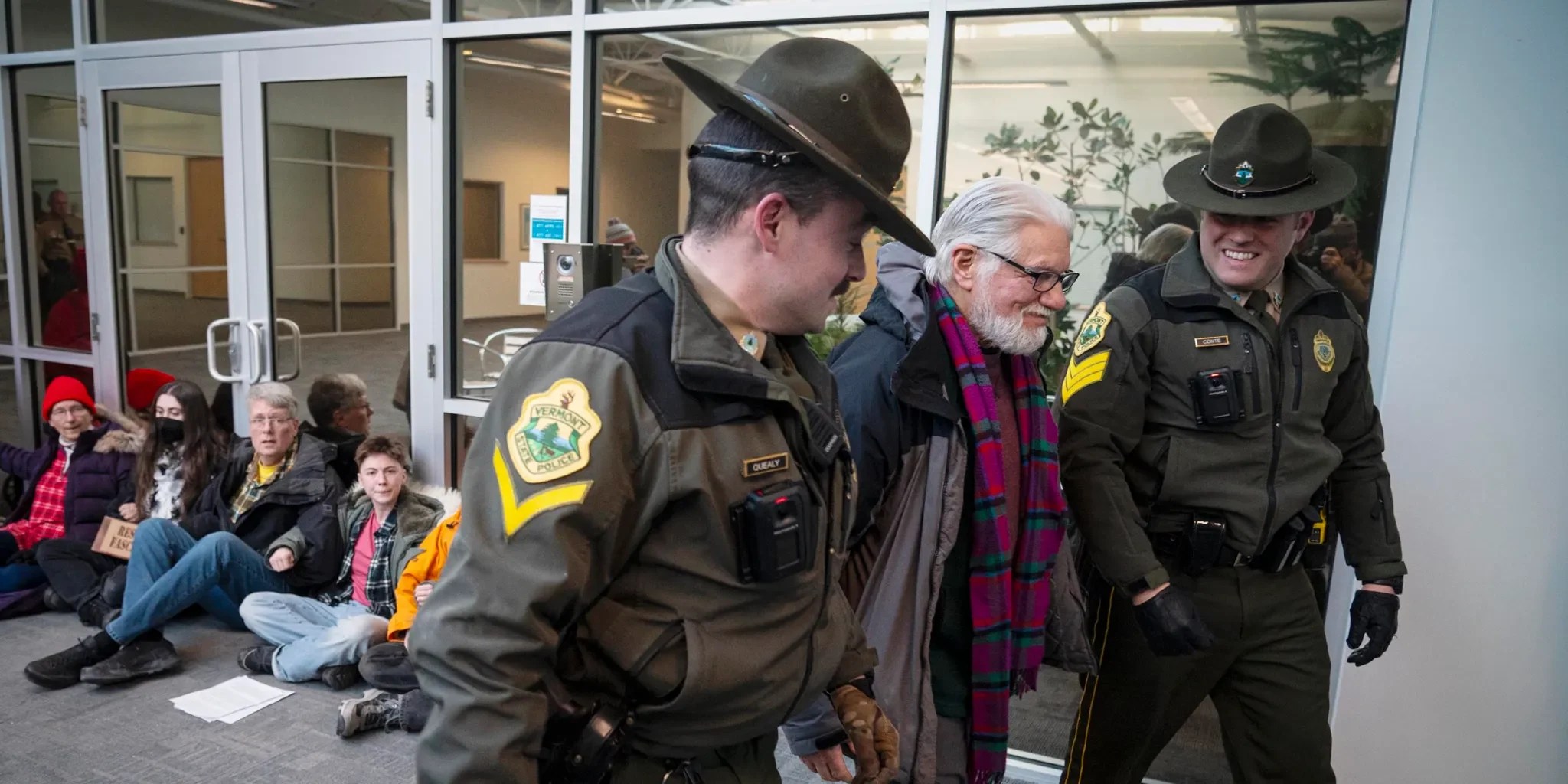
Williston, a small Vermont town of 10,000 people, is best known as a bucolic suburb of Burlington laden with historic buildings and farmland.
Like the rest of the state, the hamlet is about 90 percent white. Williston has seen few of the sorts of large-scale Trump administration immigration operations that have sparked raucous protests. Aside from a few raids against migrant farm workers, there has been little in the way of detentions by U.S. Immigration and Customs Enforcement.
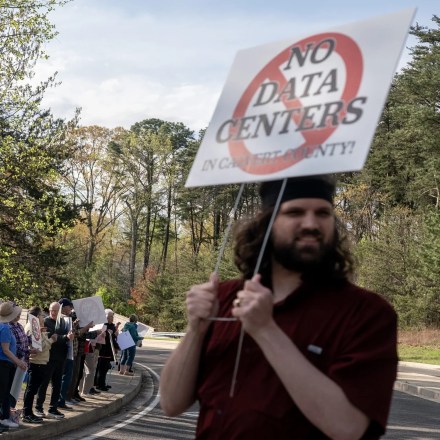
The town is, in other words, a surprising scene for the robust protests that erupted there over the past two years, with hundreds protesting against ICE.
The explanation lies in a low-slung modern building with façade of glass and dark-blue ribbed sheet metal: ICE’s National Criminal Analysis and Targeting Center, a facility designed to help identify, track, and arrest deportation targets across the country. Along with other Department of Homeland Security infrastructure in the area, the NCATC made Williston into a hub of anti-immigration enforcement.
The protests, however, weren’t initially met with the sorts of crackdown against speech experienced by other anti-ICE protesters. The local prosecutor for Chittenden County, where the surveillance center is located, repeatedly opted not to prosecute protesters arrested at the facility.
As the Trump administration ramped up its attacks against left-wing protesters, however, Williston was not spared. Beginning in September, state and federal authorities have found ways to levy criminal charges against activists.
“Our assumption has been that they did this so close to the week of action in order to try to intimidate people.”
In late September, Vermont Attorney General Charity Clark introduced surprise misdemeanor charges against 13 protesters for allegedly participating in a July sit-in at the NCATC. Then, last week, federal prosecutors unveiled surprise charges against five people, some of whom were already being charged by Clark. The five people facing federal charges, ranging in age from 22 to 80 years old, are alleged by federal authorities to have disrupted operations at the NCATC on multiple occasions.
Activists in Vermont took note of the timing: The cases came as they ramped up to launch a concerted week of protest actions against the ICE intelligence hub.
“Our assumption,” said Julie Macuga, an anti-ICE organizer involved in the protests, “has been that they did this so close to the week of action in order to try to intimidate people, in order to make people think twice about doing civil disobedience, for fear that they’re going to get charged.”

ICE in Williston
As ICE’s budget has ballooned under the Trump administration, the agency poured billions of dollars into development projects designed to expand surveillance capabilities. With astronomical goals for its deportations and a growing crackdown against dissenters, the surveillance infrastructure would provide the agency with a network of spyware for tracking migrants, protesters, and political opponents.
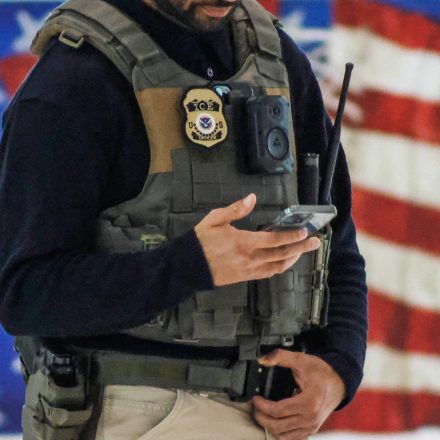
“What we’re seeing is this really huge increase in access to surveillance at both the national, state, and local level,” Michelle Dahl, an attorney who serves as the executive director of the Surveillance Technology Oversight Project. “We’re seeing that play out now in these types of surveillance dragnet centers.”
The NCATC is one of only two facilities like it in the nation. It is designed to rapidly respond to requests for information from field agents by using both open-source intelligence gathering and advanced surveillance tools to scour the internet and trawl social media for leads.
Although ICE has had facilities in Williston for years, significant efforts have been made to expand the scope of facility’s operations under the Trump administration.
According to government contractor recruiting documents first posted by ICE in 2025 and reposted this August, the NCATC is designed to employ at least a dozen analysts to answer requests 24 hours a day, coming up with target information in as little as 30 minutes. The facility operates in tandem with the office running ICE’s national tipline and its National Law Enforcement Support Center — two other major ICE facilities based in Williston.
Dahl said that despite its location, the gathering of resources in Williston is characteristic of the “fusion center” model designed to allow rapid dissemination of information between national facilities, federal agents, and local police departments.
“The fusion centers don’t have to be located in any place to collect surveillance — that’s how highly networked surveillance is across the country,” she said. “They could put it literally anywhere and be able to access the entire nationwide network.”
“No Real Precedent for It”
As a result of ICE’s expansion in Vermont, the NCATC has quickly become the subject of one of the the state’s largest recurring protests. Over the past year, hundreds of people attended rallies outside the center.
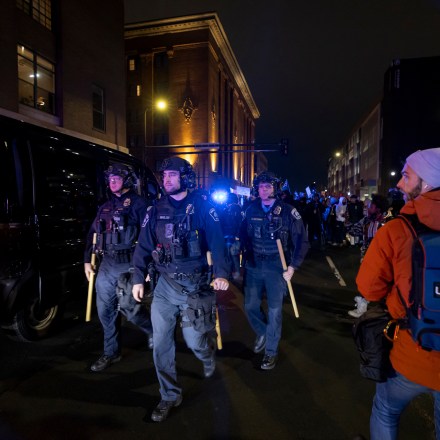
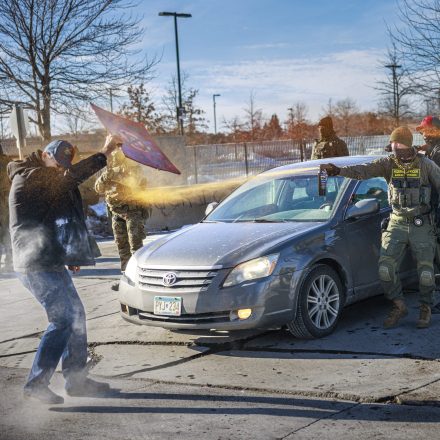
Some demonstrators took up nonviolent direct action. In one instance, clergy entered the halls and blocked an entrance. Dozens were arrested as part of the protests, but none were charged — until late September, when Clark, Vermont’s attorney general, began taking up cases that Sarah George, the state’s attorney in Chittenden County, had declined to pursue.
“We had been checking the docket and were under the impression that charges were not being pursued,” recalled Roan Wade, who was one of the 13 people charged for protesting at the facility. “It was definitely kind of a shock to have that happen.”
It later emerged that the charges had stemmed from an unusual move: The Vermont State Police began circumventing George and instead took their cases directly to the attorney general’s office. Unlike in other cases, the Vermont State Police never delivered these the charges to George’s office.
“There have been cases that Sarah George has declined, but these 13 cases were never even brought,” said state Sen. Tanya Vyhovsky, a member of the Senate Judiciary Committee, adding that the unprecedented move appeared to be legal in Vermont. “This type of stepping outside of our normal court system, as far as I can tell — and I also spoke to actual attorneys in the system — there’s no real precedent for it.”
“Extremely Concerning”
The decision to prosecute protesters for anti-ICE activity quickly ignited a firestorm among the Vermont Democratic Party establishment — which Clark, the attorney general, belongs to.
Within days of the decision becoming public, the state Senate majority leader, treasurer, and a host of representatives, candidates, and local officials all issued condemnations of the charges and Clark’s unusual actions.
“I found that decision to be extremely concerning,” Nikhil Goyal, a state Senate candidate in one of the districts containing charged protesters, told The Intercept. “There is enormous precedent, both in and out of our state, where prosecutors don’t use precious resources to go after peaceful protesters simply trying to stop a fascist machine from kidnapping our neighbors.”
“The same folks who claim to be opposing Trump and fighting this fascist administration are also prosecuting protesters.”
Wade, one of the charged protesters, says that the decision to prosecute is emblematic of wider trends among the national left, who have at times been starkly divided in their treatment of anti-ICE protests.
“It highlights some of the hypocrisy of the Democratic Party,” they said. “The same folks who claim to be opposing Trump and fighting this fascist administration are also prosecuting protesters.”
Soon, the federal charges would come down against the five additional protesters.
The Eve of Protests
The charges, both in state and federal court, were filed just ahead of the beginning of a national “week of action” organized by activists opposed to ICE’s operations in Vermont.
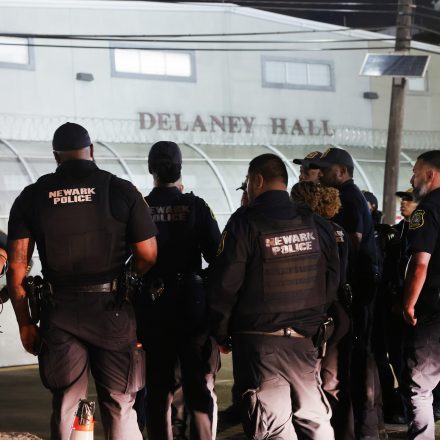
Organizers say that they expect hundreds of participants and that the protests are slated to be the largest instances of direct confrontation to ever target ICE’s national surveillance center. Some organizers say the arrests are only helping to fuel further activism.
“All it’s really done is bring a lot more attention to the issue,” said Macuga, the protest organizer.
For their part, the Vermont State Police indicated that any further charges pertaining to protests at the facility will continue to circumvent local authorities and instead be referred directly to the attorney general for prosecution. (The State Police did not respond to a request for comment.)
“Repression breeds resistance,” said Wade, the protester. “If anything, it’s caused a lot more outrage.”
IT’S EVEN WORSE THAN WE THOUGHT.
What we’re seeing right now from Donald Trump is a full-on authoritarian takeover of the U.S. government.
This is not hyperbole.
Court orders are being ignored. MAGA loyalists have been put in charge of the military and federal law enforcement agencies. The Department of Government Efficiency has stripped Congress of its power of the purse. News outlets that challenge Trump have been banished or put under investigation.
Yet far too many are still covering Trump’s assault on democracy like politics as usual, with flattering headlines describing Trump as “unconventional,” “testing the boundaries,” and “aggressively flexing power.”
The Intercept has long covered authoritarian governments, billionaire oligarchs, and backsliding democracies around the world. We understand the challenge we face in Trump and the vital importance of press freedom in defending democracy.
We’re independent of corporate interests. Will you help us?
IT’S BEEN A DEVASTATING year for journalism — the worst in modern U.S. history.
We have a president with utter contempt for truth aggressively using the government’s full powers to dismantle the free press. Corporate news outlets have cowered, becoming accessories in Trump’s project to create a post-truth America. Right-wing billionaires have pounced, buying up media organizations and rebuilding the information environment to their liking.
In this most perilous moment for democracy, The Intercept is fighting back. But to do so effectively, we need to grow.
That’s where you come in. Will you help us expand our reporting capacity in time to hit the ground running in 2026?
We’re independent of corporate interests. Will you help us?

I’M BEN MUESSIG, The Intercept’s editor-in-chief. It’s been a devastating year for journalism — the worst in modern U.S. history.
We have a president with utter contempt for truth aggressively using the government’s full powers to dismantle the free press. Corporate news outlets have cowered, becoming accessories in Trump’s project to create a post-truth America. Right-wing billionaires have pounced, buying up media organizations and rebuilding the information environment to their liking.
In this most perilous moment for democracy, The Intercept is fighting back. But to do so effectively, we need to grow.
That’s where you come in. Will you help us expand our reporting capacity in time to hit the ground running in 2026?
We’re independent of corporate interests. Will you help us?
Contact the author:
Related

Mahmoud Khalil: “We Can’t Afford to Stay Silent”
How a Small Kansas City Became a Critical Hub for Trump’s Deportation Regime Against Its Will

“They Want People Scared”: Former Palestine Action Member Blasts Trump’s Terror Sanctions
Trump’s Communist Boogeyman Playbook: Charging Protesters as Terrorists
Latest Stories

Pentagon Fears Drone Attacks on U.S. and Foreign Bases
Government officials said a series of recent attacks and threats have highlighted the vulnerability of U.S. military bases.

Bankrolling American Empire in the Philippines
The Pentagon and private capital have teamed up to militarize the island nation.

Pentagon Records Missed Almost Half of Troops’ Domestic Abuse Killings
“Records are important,” said the mother of a woman killed by her Navy colleague. We found nearly twice as many domestic-abuse killings by servicemembers as the DoD listed.