
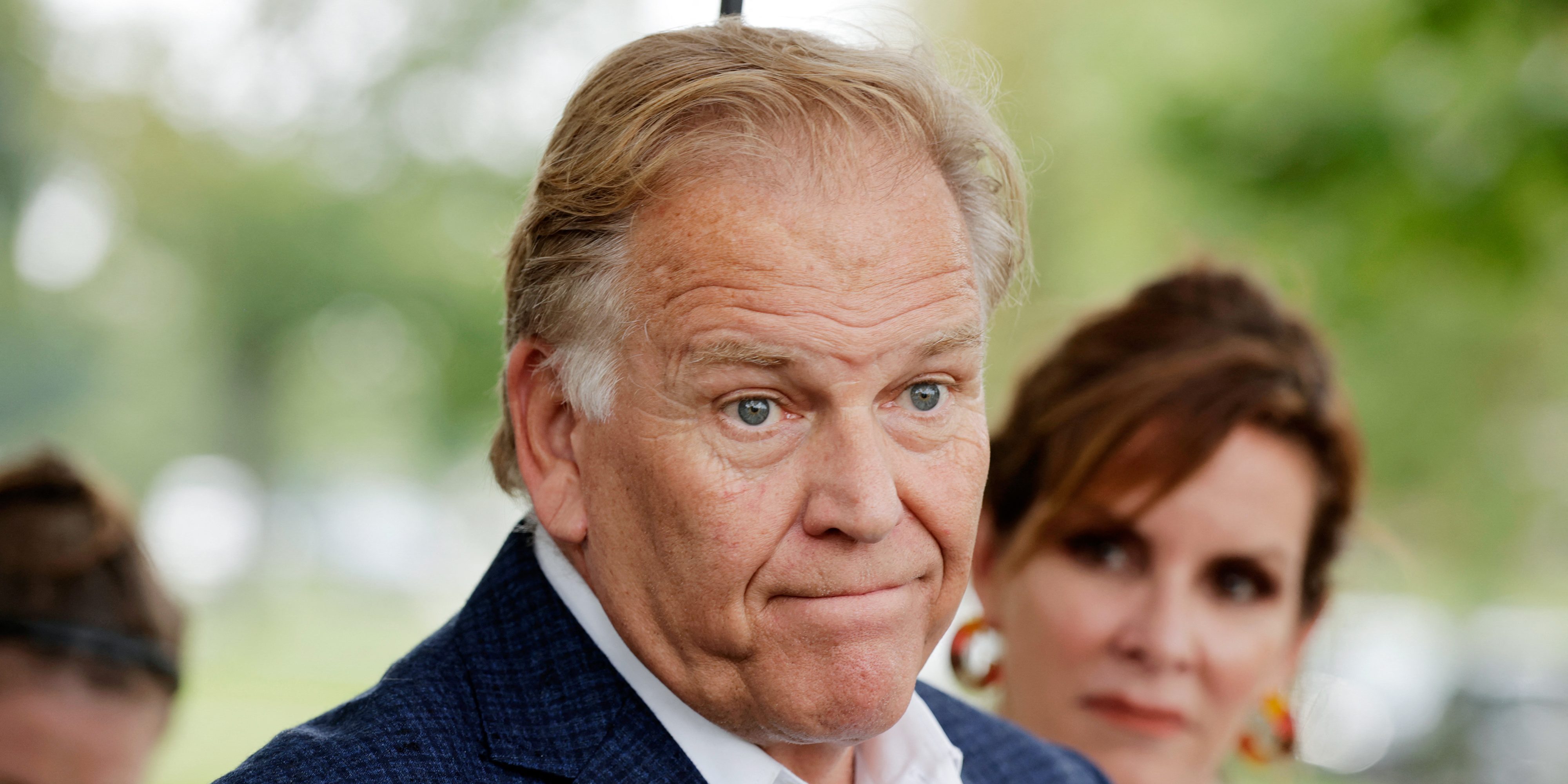
Astronomical fuel prices driven ever-higher by the U.S.–Israel war in Iran might be hitting Mike Rogers, too.
The Republican candidate for Senate in Michigan spent more than $40,000 to cover a single private jet bill last month, according to campaign finance records reviewed by The Intercept. The five-figure ticket was part of over $100,000 worth of campaign cash Rogers spent on luxury travel last quarter, most of it on private jet trips.
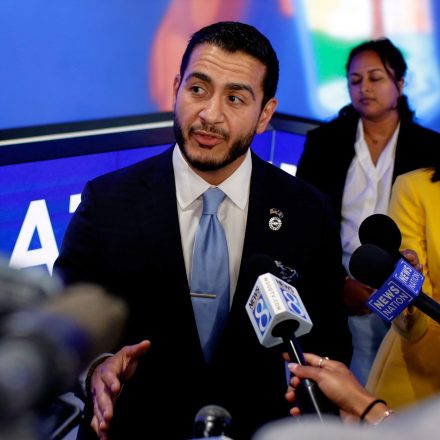
As economic woes shape the Michigan Senate race, Roger’s opponent, Democratic candidate and former public health official Abdul El-Sayed, has attacked the Republican repeatedly for his ties to corporations and billionaire donors. Rogers, who represented Michigan’s 8th District in the House from 2001 to 2015, regularly advocated in Congress to let lawmakers receive gifts and other benefits from restricted nonprofit groups. He helped defeat a 2006 bill that would have cracked down on former congressional members’ lobbying activities and banned certain privately funded trips.
For Jeffrey Hauser, a critic of corporate political influence, Rogers’s newly revealed campaign spending on luxury services might spell a warning to Michigan voters feeling the crunch of a struggling economy.
“It seems like Mike Rogers has developed a real taste for the finer things,” said Hauser, director of the Revolving Door Project, which is not backing any candidate in the Michigan race. “That means he is likely to want to continue to court, and be courted by, the economic elite, which portends badly for working class Michiganders who prefer their Senator have some understanding of their lives and identification with their interests.”
In September, the Rogers campaign paid $93,152 to JL Jets for at least five separate private charter flights, including the $40,000 transaction. Around the same time, the campaign also dropped another $500 on the luxury chauffeur company Blacklane. From July to September, Rogers’s campaign paid an additional $4,527 to Blacklane for luxury car services, including a $2,078 chauffeur expense on August 17. The campaign spent $683 on a pair of limo rides in August and September.
Campaigning requires a lot of travel, and El-Sayed’s campaign finance records show higher total travel costs — roughly $330,000 last quarter, according to public filings. But those funds went toward commercial flights on Delta and American airlines, Hertz car rentals, gas, Uber and Lyft rides, and hotel accommodations.
El-Sayed had a busier campaign calendar with a competitive Democratic primary against Rep. Haley Stevens, while Rogers was the presumed Republican nominee since the early days of the race. El-Sayed’s campaign said he did more than 500 events ahead of the August primary, and Rogers has carried a more relaxed schedule into the general election cycle.
In a statement to The Intercept, a spokesperson for Rogers pointed to El-Sayed’s spending on meals and travel on the campaign trail as well as a series of high-dollar contributions his father-in-law made to a super PAC backing the campaign.
“Abdul El-Sayed reimbursed himself $90K, and his father-in-law, a senior advisor of CAIR, gave his SuperPAC $300K,” said Rogers campaign spokesperson Abby Ronson. “If the Intercept is looking for an FEC story, I’d take a long hard look at Abdul.” The El-Sayed campaign did not immediately respond to a request for comment.

If elected, Rogers wouldn’t be the only U.S. senator to spend big on private jets. He would appear to compete with top spenders. As public scrutiny has driven politicians away from chartered flights, only Sens. Mike Rounds, R-S.D., and Kirsten Gillibrand, D-N.Y., spent more on private flights than Rogers did last quarter, Axios reported — and they spent it over the course of a year and a half.
The Rogers campaign did book some flights with airlines like Frontier and Southwest, spending about $29,000 on 10 flights, but luxury transportation accounted for the vast majority of the campaign’s travel expenses last quarter.
Among Rogers’s hotel spending was a $2,000 stay at The Breakers, a luxury oceanfront hotel in Palm Beach, Florida; another $1,295 at the Grand Traverse Resort and Spa in Michigan; and $200 at the five-star Palazzo at The Venetian Resort in Las Vegas. In addition to travel costs, the campaign paid $2,165 to its deputy campaign manager Tyler Henningsen in late September for car repairs at a BMW dealership in Bloomfield Hills, one of Michigan’s most affluent areas. Henningsen did not immediately respond to The Intercept’s request for comment, but the Rogers spokesperson said the car was used for campaign purposes.
Luxury transportation accounted for the vast majority of the Rogers campaign’s travel expenses last quarter.
Campaign finance rules state that spending on travel and vehicle costs is allowed, as long it’s strictly for campaign purposes. It is generally illegal to use campaign funds for personal travel; if a person uses campaign funds for mixed personal and campaign travel, they have to reimburse the campaign within 30 days. If the campaign pays for a car, that car can only be used for campaigning.
Rogers holds significant personal investments in the real estate, artificial intelligence, and cybersecurity industries. His Senate campaign has received significant backing from corporate figureheads such as billionaires, Apollo Global Management CEO Marc Rowan, the DeVos family, and Elon Musk, who through his super PAC, America PAC, has poured into the race more than $6 million since Rogers promised to “shield” the world’s richest man from congressional oversight.
On the debate stage, El-Sayed has targeted Rogers’s home in Florida and his two “yachts,” attempting to paint the former congressman as out-of-touch from everyday, working Michiganders. Public records show Rogers owned two boats measuring 32 and 39 feet in Maryland, though he reportedly sold one of them. Rogers is attempting to sell his Florida home and is living full-time in Michigan, according to news outlet Bridge Michigan.
While Rogers was in Congress, he chaired the House Intelligence Committee and was a key supporter of the Patriot Act, pushing to expand domestic spying powers. Toward the end of his time in Congress, in 2013 and 2014, he and his wife Kristi attended a pair of weekend retreats at a five-star resort, The Cloister in Sea Island, Georgia, on the dime of the right-wing think tank American Enterprise Institute. At the 2014 forum, described in 2022 by CBS News as “a private, off-the-record gathering of conservative leaders and wealthy donors,” Rogers spoke as a panelist in his capacity as House Intelligence Committee chair on “cybersecurity and national security issues,” disclosure forms said.
Alongside Rogers, the 2014 event featured prominent conservative figures as speakers, such as then-House majority leader Rep. Eric Cantor, R-Va.; Iraq War architect Karl Rove; then-Sen. Marco Rubio, R-Fla.; New York Times columnist David Brooks; then-president of the National Economic Council Gene Sperling; and Keith Alexander, director of the National Security Agency under presidents George W. Bush and Barack Obama. Also in attendance were Betsy and Dick DeVos, Donald Trump’s first-term education secretary and former Amway CEO, respectively, who have since funded Rogers’s current run and several past campaigns.

A few weeks after the conservative retreat, Alexander stepped down as NSA director under the cloud of the Edward Snowden leaks revealing the U.S. government’s role in a global spying network. That year Alexander founded cybersecurity firm IronNet, which hired Rogers in 2015 after he decided not to run for reelection. He was later elevated to a board role at IronNet — which has since gone bankrupt — and received more than $700,000 in payments and held stock with the company worth $250,000 to $500,000, according to financial disclosure forms.
“Politicians spend enormous amounts of time with the super rich, either because they are seeking to raise money from them, consulting with them about the economy, or both,” Hauser said. “As a result, they start to develop expensive tastes.”
IT’S EVEN WORSE THAN WE THOUGHT.
What we’re seeing right now from Donald Trump is a full-on authoritarian takeover of the U.S. government.
This is not hyperbole.
Court orders are being ignored. MAGA loyalists have been put in charge of the military and federal law enforcement agencies. The Department of Government Efficiency has stripped Congress of its power of the purse. News outlets that challenge Trump have been banished or put under investigation.
Yet far too many are still covering Trump’s assault on democracy like politics as usual, with flattering headlines describing Trump as “unconventional,” “testing the boundaries,” and “aggressively flexing power.”
The Intercept has long covered authoritarian governments, billionaire oligarchs, and backsliding democracies around the world. We understand the challenge we face in Trump and the vital importance of press freedom in defending democracy.
We’re independent of corporate interests. Will you help us?
IT’S BEEN A DEVASTATING year for journalism — the worst in modern U.S. history.
We have a president with utter contempt for truth aggressively using the government’s full powers to dismantle the free press. Corporate news outlets have cowered, becoming accessories in Trump’s project to create a post-truth America. Right-wing billionaires have pounced, buying up media organizations and rebuilding the information environment to their liking.
In this most perilous moment for democracy, The Intercept is fighting back. But to do so effectively, we need to grow.
That’s where you come in. Will you help us expand our reporting capacity in time to hit the ground running in 2026?
We’re independent of corporate interests. Will you help us?

I’M BEN MUESSIG, The Intercept’s editor-in-chief. It’s been a devastating year for journalism — the worst in modern U.S. history.
We have a president with utter contempt for truth aggressively using the government’s full powers to dismantle the free press. Corporate news outlets have cowered, becoming accessories in Trump’s project to create a post-truth America. Right-wing billionaires have pounced, buying up media organizations and rebuilding the information environment to their liking.
In this most perilous moment for democracy, The Intercept is fighting back. But to do so effectively, we need to grow.
That’s where you come in. Will you help us expand our reporting capacity in time to hit the ground running in 2026?
We’re independent of corporate interests. Will you help us?
Contact the author:

Related


Latest Stories

Kohen Wiley’s Family Says Investigators Didn’t Contact Them Before Concluding Cops Did No Wrong
Mississippi has yet to release any support for its claim that a “thorough and impartial” review showed the shooting was “justified.”

Targeting Iran
Yemenis Unable to Reach Hospital Are Part of the Iran War Death Toll
At least 10 patients with kidney failure near Taiz, a city under a Houthi siege, died because they were unable to get to their dialysis treatments.

The Army Wants to Sic AI Agents on Its Enemies. What Could Go Wrong?
Documents obtained by The Intercept show the military is trying to deploy autonomous AI agents to hack its adversaries.